




How to Roll Out Healthcare Surcharging at Your Specialty Practice
By Blakely Roth | July 15, 2026
For mid-to-large specialty practices, credit card processing fees have moved from a back-office line item to a board-level margin issue. Without a compliant surcharging strategy, practice processing $12 million annually in card volume can absorb $240,000 to $360,000 in merchant fees every year. Those profits never reach the bottom line — and it compounds quietly, year over year.
Surcharging is one of the fastest ways to recover that margin. One in four healthcare transactions now includes a surcharge, and 30% of healthcare leaders are exploring or have already implemented it. The financial case is clear. The harder question is operational: how do you actually roll surcharging out without creating compliance risk, billing rework or front-desk burden?
Consider this guide as your rollout playbook.
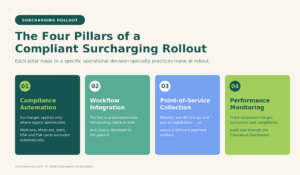
The Four Pillars of a Compliant Surcharging Rollout
A successful surcharging program rests on four operational pillars. Skip any one of them and the program either leaks profits, creates compliance exposure or pushes manual work back onto staff.
- Compliance automation: surcharges are only applied where they’re legally permissible
- Workflow integration: the fee is presented inside the existing check-in flow and clearly disclosed
- Point-of-service collection: patients see the charge and pay at registration or select a different payment method
- Performance monitoring: collections, exclusions and recovered savings are tracked through reporting
Each pillar maps to a specific operational decision. Here’s how high-volume specialty groups are sequencing them.
Step 1: Put Compliance First
Surcharging carries firm regulatory guardrails. The non-negotiables:
- No surcharging on Medicare or Medicaid-covered services. Federal regulations prohibit it.
- No surcharging on debit, HSA, FSA, or prepaid cards, Per card network rules and federal law.
- A 3% cap on Visa transactions, and parallel network-specific limits across Mastercard, Discover and American Express.
- State-specific rules. A handful of states restrict or cap surcharges further; some require additional disclosures.
- Itemized receipts and pre-transaction disclosure at the point of sale.
- Dive deeper into key compliance considerations here.
See how Clearwave makes compliant surcharging simple.
Step 2: Automate the Payment Strategy
Compliance automation is only one half of the equation. The other half is making sure the surcharge is applied accurately at every touchpoint where a patient can pay — and that the experience simplifies the payment for patients and staff.
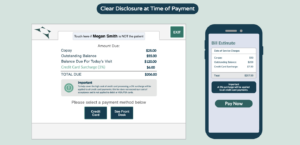
For example, with Clearwave, surcharging is layered into that existing flow rather than introduced as a separate step. Across kiosk, mobile, tablet and dashboard, the surcharge is calculated, disclosed and itemized automatically. The patient sees:
- A clear breakdown of charges (copay, outstanding balance, balance due for today’s visit)
- The credit card surcharge as a separate line item
- A pre-transaction disclosure explaining the fee, the exclusions, and the alternative payment options
- A choice — pay by credit card with the surcharge, or use an alternative (debit, HSA/FSA) with no fee
Modern payment methods are part of the same workflow. Tap-to-pay, Google Pay and Apple Pay are all supported, which keeps the patient experience fast and contactless even with the additional line item present.
For billing and revenue cycle teams, the operational impact is close to zero. The fee is calculated, applied, disclosed and recorded automatically. There’s no manual math, no separate posting, no exception queue.
Step 3: Collect More at the Point-of-Care
Surcharging fees only materialize if patients actually pay at registration. This is where specialty practices with a mature point-of-service collection workflow have a structural advantage — they’ve already solved the harder problem of getting patients to pay before they see the provider.
For practices using a patient-led registration solution, the surcharge is presented at the same moment the patient is already paying their co-pay or outstanding balance. There’s no second touchpoint, no follow-up bill and no statement chase. Clearwave clients using kiosks see 95% of patients making their copay payment at check-in and collection rates increase by 85%. Adding surcharging to that same workflow extends the same collection mechanics to the processing fee itself.
The point-of-service moment also gives the patient agency. The disclosure makes the fee visible before payment, while alternative payment methods are presented alongside it. The patient chooses — and either outcome works for the practice. A patient who pays by credit card covers the processing fee. A patient who switches to debit or HSA eliminates the fee from the transaction entirely. Either way, the practice’s margin is protected.
Step 4: Monitor Performance and Track Success
The final pillar is measurement. A surcharging program that isn’t tracked is a program that can’t be optimized and can’t be defended in an audit.
Through the Clearwave Dashboard, practice administrators and revenue cycle leaders can pull reports on surcharged collections and recovered processing fees. This visibility supports three things:
- ROI confirmation: quantifying the margin recovered against the original processing fee spend
- Compliance audit trail: a record of which transactions were surcharged
- Operational fine-tuning: identifying patterns by location, payer mix or card type that may warrant a policy adjustment
For multi-location organizations, this reporting becomes the foundation for scaling the program. Once one site is operational and the numbers are validated, the rollout extends to the next.
The Practices Best Positioned to Roll Out Surcharging
Surcharging isn’t a one-size-fits-all strategy. Practices most likely to see strong returns share a few characteristics:
- High monthly credit card processing volume
- Multiple locations with centralized payment workflows
- An existing digital patient journey (kiosk, mobile check-in, or tablet)
- A patient base accustomed to self-service payment
- A patient-led registration solution that can automate determinations and disclosures end-to-end
If your practice fits this profile, the operational lift to add surcharging is smaller than most administrators expect — because the infrastructure is already in place. The surcharging logic is a configuration layer on top of the registration and payment workflow your team and patients are already using.
Ready to Add Surcharging to Your Existing Workflow?
Clearwave helps high-volume specialty practices launch compliant surcharging with automated compliance determinations, embedded disclosures and full performance reporting.
Schedule a demo today to see how surcharging fits into your current registration and payment workflow.
Related reading: Is Surcharging Worth the Risk?· The Rise of Surcharging in Healthcare: Trends and Implications · MGMA: Credit card surcharges for medical practice payments
Disclaimer: This resource is designed to inform healthcare practices about compliant surcharging implementation. It is not intended as legal, financial or operational advice. Practices should perform their own due diligence and consult with legal counsel before implementing a surcharging or cost recovery policy.