




How Much Can Healthcare Surcharging Save Your High-Volume Practice?
By Blakely Roth | June 24, 2026
For specialty practice administrators and revenue cycle leaders, credit card processing fees are one of the most predictable — and most overlooked — drains on margin. At high volumes, these fees add up to hundreds of thousands of dollars a year.
Healthcare surcharging is one of the fastest, most direct ways to recover that margin. The financial math is straightforward, but the actual savings depend on a practice’s monthly credit card volume, payer mix and ability to apply the surcharge compliantly.
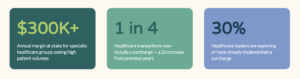
Here’s what specialty practices are actually saving and what it takes to capture those numbers.
The Direct Answer: What Surcharging Saves by Volume
At a typical 3% surcharge rate, here’s what a specialty practice stands to recover based on monthly payment volumes:
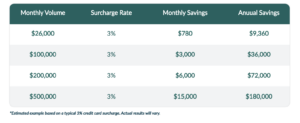
Estimated based on a typical 3% credit card surcharge applied to eligible transactions. Actual results vary based on payer mix, card type distribution and state-specific regulations.
For practices at the higher end of that table, surcharging recovers what amounts to the cost of multiple FTEs every year — without touching the fee schedule, raising prices for patients paying by other methods or absorbing the loss in margin. For many leaders today, it’s worth testing out.
The Real Cost of Absorbing Processing Fees
Most specialty practices are paying between 2% and 3% in credit card processing fees on every card transaction. That’s the cost of accepting credit cards — and historically, it’s been treated as a fixed cost of doing business.
For a single-location practice with modest card volume, those fees might amount to a few thousand dollars a year. Inconvenient, but absorbable. For mid-to-large specialty practices, the math is materially different. A multi-location healthcare group processing $12 million annually in credit card payments is paying:
- $240,000 per year at a 2% processing rate
- $360,000 per year at a 3% processing rate
Compliant, healthcare surcharging changes the equation. A compliant 3% surcharge applied through an automated system can offset most of those fees — protecting up to $360,000 in margin annually for a $12M practice.
A Worked Example for a Multi-Location Healthcare Group
Here’s how the numbers play out for a typical multi-location specialty practice, or dive deeper here.
Healthcare practice profile:
- 6 locations
- 30+ providers
- $12M in annual credit card processing volume
- Mixed payer base (commercial, Medicare, Medicaid, self-pay)
Before surcharging:
- Annual processing fees at 3%: $360,000
- Those profits are absorbed as a cost of doing business
- No mechanism to recover it without raising fee schedules
After compliant surcharging:
- Surcharge applied only to eligible transactions (excludes Medicare/Medicaid-covered services, debit, HSA/FSA)
- Annual recovered margin: up to $360,000
- Patients paying by debit, HSA, FSA or alternative methods see no fee
- Compliance determinations handled automatically — no front-desk math
The recovered margin in this example is roughly equivalent to:
- 3–5 additional staff members to support expanded location capacity
- A technology reinvestment in automation, AI tools or front-office infrastructure
- The operating runway to add a provider or extend hours at existing locations
For high-volume specialty groups, this is no longer a marginal consideration. It’s a board-level margin recovery strategy.
Why the Cost Savings Hold Up Best With Automation
The savings figures above assume one important condition: the surcharge is applied accurately, every time and on every eligible transaction.
Manual surcharging is where the math starts to slip. Front-desk teams calculating fees on the fly, applying them across mixed card types or trying to track which services are eligible introduces error — and every error chips away at the recovered margin. The common pain points:
- Card-type accuracy: surcharges must apply only to credit cards, never to debit, HSA or FSA cards
- Service-type accuracy: Medicare and Medicaid-covered services are excluded by law
- Disclosure consistency: patients need a clear, pre-transaction disclosure every time, not staff scripting that varies by location
- Receipt itemization: every transaction needs an itemized receipt showing the surcharge as a separate line item
- Dive deeper here.
Automated surcharging, through Clearwave’s patient-led registration platform, handles each of these complexities instantly. The fee is calculated only on eligible transactions. Disclosures are presented automatically. Receipts are itemized. Staff are out of the equation entirely.
Where the Surcharging ROI Multiplies
For specialty practices already running a digital point-of-service collection workflow, surcharging compounds on top of existing collection performance. For example, practices using Clearwave kiosks see:
Adding compliant surcharging on top of that collection infrastructure simplifies the collections process and provides the transparency patients expect while saving practies money every day. Patients are already paying at registration. The surcharge is presented in the same workflow. The fee is recovered on the same transaction. There’s no second touchpoint, no statement chase and no back-end reconciliation.
Is Surcharging the Right Move for Your Practice?
Surcharging delivers the strongest financial return for specialty practices that:
- Process high monthly credit card volumes (typically $100K+/month)
- Operate multiple locations with centralized payment workflows
- Have a patient base that’s comfortable with self-service payment
- Use a patient-led registration solution capable of automating compliance determinations
- Need to protect margin against rising operational costs without raising fee schedules
For practices that fit this profile, the math is direct: surcharging recovers a fixed percentage of card volume that’s currently being absorbed as a processing cost. Compliant automation makes the recovery sustainable.
Evaluate if surcharging is right for your practice with insights from this guide for healthcare leaders.
Calculate Your Practice’s Surcharging Recovery
Want to see what compliant surcharging could recover for your specialty practice? Clearwave works with high-volume specialty groups to model the financial impact, evaluate operational readiness and launch surcharging across kiosk, mobile, tablet and dashboard transactions.
Schedule a demo today to model your practice’s surcharging recovery.
Related reading: Is Surcharging Worth the Risk?· The Rise of Surcharging in Healthcare: Trends and Implications · MGMA: Credit card surcharges for medical practice payments
Disclaimer: This resource is designed to inform healthcare practices about the financial implications of surcharging. It is not intended as legal, financial or operational advice.
Estimated savings are based on a typical 3% credit card surcharge applied to eligible transactions; actual results will vary based on payer mix, card type distribution and state-specific regulations. Practices should perform their own due diligence and consult with legal counsel before implementing a surcharging or cost recovery policy.