


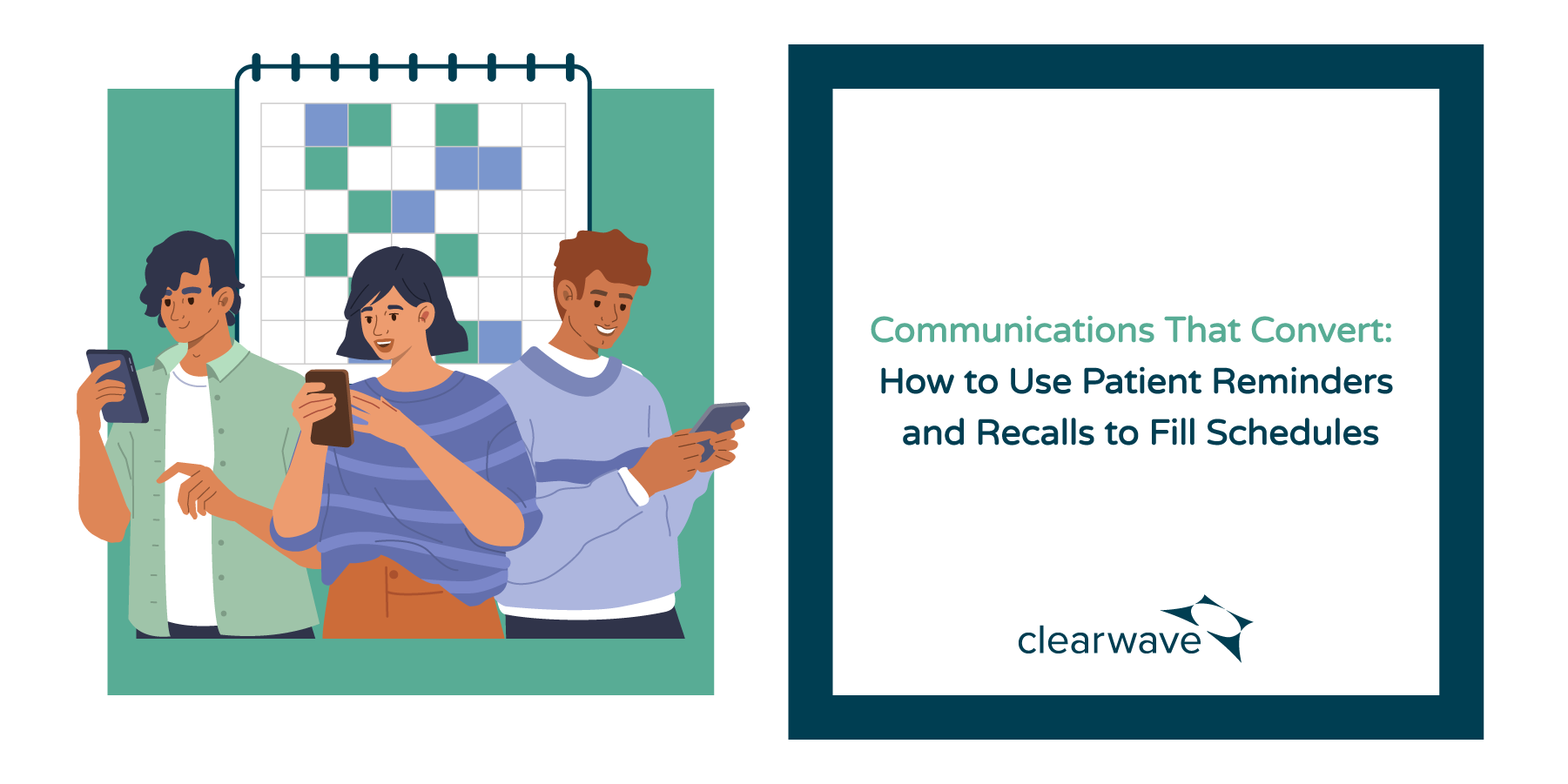
Communications That Convert: How to Use Patient Reminders and Recalls to Fill Schedules
By Chloe From Clearwave | Febuary 2, 2026
Every empty appointment slot represents lost revenue, disrupted workflows and missed opportunities to serve patients who need care. When a patient misses a follow-up for diabetic retinopathy screening or fails to schedule their post-operative cataract appointment, the clinical consequences can be significant, and the financial impact compounds quickly.
The average no-show costs a practice $200 per unused time slot. Multiply that deficit across weeks and months, and you’re looking at substantial revenue leakage that could have been prevented with new, proven communication strategies.
See the communications strategies that practices are using to reduce empty appointment slots and how you can leverage these tools to fill your schedule!
The Cost of Outdated Communication Methods
If your practice still relies primarily on phone calls for appointment reminders and patient recalls, you’re likely experiencing frustrations like:
- Endless voicemails
- Phone tag,
- Bottlenecks and loss of time due to repetitive outreach
- Patients who simply don’t respond to traditional communications
With the new year comes troubling numbers for specialty practices: 60% of patients with diabetic retinopathy are lost to follow-up yearly, and the average practice faces a 17% patient attrition rate. These numbers represent patients who need ongoing care but fall through the cracks when communication systems fail to keep them engaged.
Why Traditional Recall Systems Fall Short
Patients in our modern world expect the convenience of text messages, online scheduling and automated reminders that fit seamlessly into their busy lives.
Most specialty medical offices understand the importance of patient recalls in theory. The challenge lies in execution. Manual recall systems demand significant staff time, are prone to human error and often fail to reach patients through their preferred communication channels.
Consider the typical scenario: A staff member pulls a list of patients due for annual glaucoma screenings, begins making phone calls, leaves voicemails for most patients and maybe reaches a handful directly. Days later, they repeat the process with patients who haven’t responded.
Hours of staff time invested with minimal return, and most importantly, patients who still haven’t scheduled their necessary appointments.
The problem is that manual systems can’t compete with automated patient reminders that reach patients instantly, across multiple channels, with personalized messaging that speaks directly to their clinical needs.
Proven Patient Recall Software for Specialty Clinics
Forward-thinking practices are discovering how patient recall software for specialty clinics can transform this entire equation. Instead of staff spending hours on repetitive phone calls, intelligent AI and automation can handle the heavy lifting, while your team remains focused on high-value patient interactions.
Here’s what effective automated patient reminders—that truly reduce no-shows at specialty practices—look like in action:
Automated Appointment Reminders: Multi-channel reminders via text, email and phone ensure patients receive timely notifications in their preferred format. These are personalized communications that include appointment details, preparation instructions and one-click confirmation or rescheduling options.
Want to see success in action? Take a look at how one FQHC personalized reminders to improve patient outcomes and ensure on-time arrivals.
Strategic Recall Campaigns: Whether it’s annual comprehensive eye exams, post-surgical check-ins, or disease-specific monitoring appointments, get strategic to ensure patients receive timely, relevant reminders without any manual intervention.
See how one practice automatically identifies patients due for follow-up care based on their clinical history and triggers targeted outreach.
Intelligent No-Show Recovery: When patients miss appointments, automated workflows immediately engage them with rescheduling options. CompEye’s 32% conversion rate on no-show reactivations demonstrates the power of immediate, persistent, but non-intrusive follow-up.
Here’s another example of an FQHC that implemented a smart no-show reactivation strategy.
Referral Reactivation: Perhaps most valuable for specialty practices, automated systems can identify and re-engage patients who were referred to your practice but never scheduled. CompEye’s 48% booking rate after referral reactivation showcases the significant revenue hiding in your existing referral pipeline.
Using Communications to Fill Cancellations
One of the most powerful applications of modern patient communication technology is using these notifications to fill cancellations before another slot goes to waste. Every practice deals with last-minute cancellations, but few have systems to rapidly and automatically fill those slots.
Consider a dynamic waitlist that can instantly notify appropriate patients when slots become available. If a patient cancels a Tuesday morning glaucoma consultation, the system immediately identifies patients who’ve been waiting for earlier appointments and sends notifications within minutes. This real-time responsiveness transforms scheduling challenges into opportunities to serve more patients and maintain revenue flow.
Key Features That Drive Results
When evaluating patient reminder and recall solutions for your specialty practice, focus on capabilities that directly address your unique challenges:
Multi-Channel Flexibility: Patients should receive communications via their preferred channels (voice, text or email) with consistent messaging across all touchpoints.
Intelligent Timing: Messages should reach patients at optimal times based on appointment type and patient preferences, with an appropriate frequency that engages without overwhelming.
Personalization at Scale: Every communication should feel individually crafted, incorporating patient names, specific appointment details, provider information and relevant clinical context.
Actionable Messages: One-click confirmation, rescheduling and pre-registration capabilities eliminate friction and make it easy for patients to engage immediately.
Analytics and Optimization: Robust reporting should reveal which communication strategies work best for different patient segments, enabling continuous improvement.
EHR Integration: Seamless data flow between your practice management system and communication platform ensures accuracy and eliminates duplicate data entry.
Success Story: 32% Patient No-Show Reactivation Rate
The partnership between Comprehensive EyeCare Partners, Clearwave and Vital Interaction provides a compelling example of what’s possible when specialty practices modernize their patient communication strategy.
Specifically related to their reactivation strategies, CompEye saw:
- 76% increase in premium IOL conversion rates (jumping from 29% to 51%)
- 48% of bookings made from new patient referral reactivation messages
- 32% of bookings made from no-show/cancellation reactivation messages
- 29% of bookings made from annual reactivation messages
These results emerged from a comprehensive approach to patient engagement that recognizes communication as a strategic asset, not just an administrative task.
Watch the full conversation here to see how they’ve successfully launched AI-powered recalls and automation that drives patients into the practice and increases revenue across the board.