



2027 Spotlight: What Healthcare Leaders Are Focused On
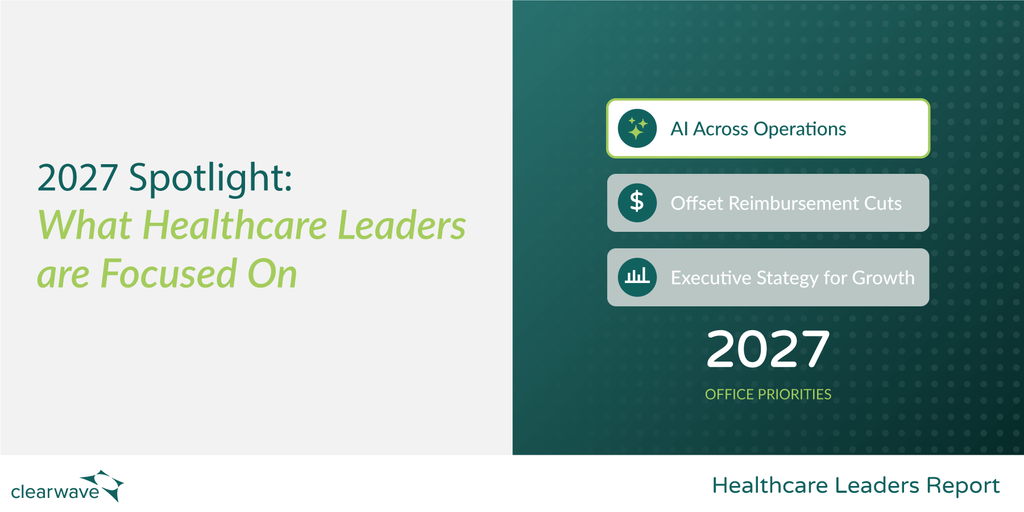
Rising wages, shrinking reimbursements and leaner teams are being felt at every level of many healthcare organizations. In a recent report on healthcare leadership priorities, which surveyed 100+ healthcare leaders across operations, these upcoming financial hurdles were a recurring theme..
Staffing is an essential investment in patient care. With costs climbing and AI reshaping the equation, healthcare leaders are looking for every opportunity to better support their existing teams and reduce the constant cycle of churn and rehiring. See what over 100 healthcare leaders are doing right now to support their top performers while overcoming financial burdens.
The Numbers That Show How the Corner Office Sees 2027
Executive answers on staffing looked strikingly different from those of managers, directors, individual contributors and clinicians. Leaders who own the budget tend to see staffing as a cost problem first, while teams on the floor feel it as a workload problem. That difference in perspective shows up clearly in the numbers.
1. Staffing Costs Are the Top Financial Constraint
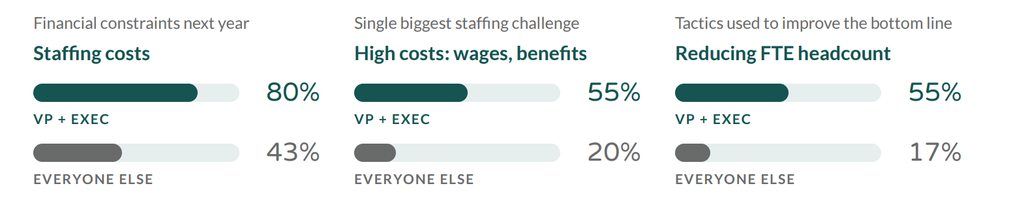
When asked which financial constraints will affect them most next year, 80% of VPs and executives named staffing costs, compared with 43% of everyone else. For four in five executives, payroll is the line item that shapes 2027.
2. Wages and Benefits Are the Single Biggest Challenge
More than half of executives called high wage and benefit costs their single biggest staffing challenge, versus 20% of the rest of the organization. Managers on the floor still feel turnover, burnout and coverage gaps day to day. Executives are looking at what those gaps cost to fill.
3. Headcount Is on the Table
Nearly 55% of executives are reducing FTE headcount to improve the bottom line, compared with just 17% of everyone else. Across all respondents, that figure sits at 24%.
These gaps come down to vantage point. Executives see the full cost of every manual workflow across every location, while front-line leaders see the workload those workflows create. Both are right, and the strongest 2027 plans account for each priority.
Why Executives Are Leading the AI Charge
If staffing costs remain a top concern, executives are clear on where they expect relief. They are roughly twice as likely as the rest of the organization to see AI as the fix for the most manual work on staff’s plate.
- Revenue cycle and collections: 55% of executives vs. 28% of everyone else
- Patient communications: 70% of executives vs. 35% of everyone else
These are the areas where repetitive work piles up fastest. Every reminder, payment follow-up and eligibility recheck is a task a team member repeats all day long. Accelerating the revenue cycle and automating patient communications take that volume off the team without touching the parts of the job that need a person.
The data by organization size points in the same direction. Voice AI climbs as a priority with every step up in size, from 24% at practices with 1–25 providers to 29% at 26–99 providers and 38% at organizations with 100+ providers. For a large group, a repetitive phone task doesn’t happen once. It happens across every location, every day, which is why Voice AI for healthcare ranks higher on enterprise roadmaps.
Redirect the Team, Don’t Replace Them
The finding that 55% of executives are cutting headcount makes for a dramatic headline, but the report’s executive action plan points somewhere more sustainable. The goal isn’t to replace staff with automation. It’s to redirect staff toward the highest-value work in their day and absorb the manual work that’s slowing them down.
What does that look like in practice?
- Work to automate: Call answering, scheduling, insurance and benefits checks, pre-visit outreach, check-in, data intake and collections
- Work to keep human: Financial counseling, complex billing questions, patient advocacy and the conversations patients remember
Eligibility is a good example. When automated insurance eligibility verification runs before the visit—flagging issues for front-office staff to tackle prior to care—the amount of post-visit challenges is greatly reduced. Practices can also save staff time with AI for phone management. By using Voice AI to resolve routine calls and book patients, call volumes for human agents become more manageable. As a result, when patients are routed to a human agent, those agents no longer need to rush through a queue and can spend their time resolving patient needs, reducing waits and abandoned calls.
Dive deeper into the answered call problem if you’re facing an influx of calls that seem unabsorbable..
Revenue cycle leaders who’ve made the shift to automation and AI describe it in terms of visibility as much as savings. As Patrick Zuniga, AVP of Revenue Cycle Management at Sheltering Arms Institute, shared in the report:
“Clearwave has given our team the visibility and automation we need to maximize the capture of co-pays, co-insurance and deductibles at the time-of-service…the impact on our bottom line has been measurable and consistent.”
The payoff of redirecting rather than replacing is the same team, fewer preventable errors, and more time for patients.
One Platform, For a Consistent Workforce for 2027
There’s one more piece of the executive playbook. Phones, eligibility and payments are usually treated as three separate problems with three separate vendors, and every handoff between them becomes manual work for staff. That’s the hidden cost of vendor sprawl many leaders are confronting during budget season.
The report’s through-line for 2027 is consistent in that leading organizations are choosing one agentic platform for every workflow and handoff. With AI agents across voice, scheduling, eligibility, intake, check-in, payments and outreach working inside a single system, the team already in place can manage more patient volume without taking on more repetitive work.
Bring the Corner Office View Into Your 2027 Plan
Executives and front-line leaders are looking at the same problem from different floors. The organizations that come out ahead in 2027 will close that gap, using automation to control staffing costs while giving their teams back the time to do the work only people can do.
Get the full executive breakdown, year-over-year trends and payments spotlight in The 2027 AI Healthcare Leadership Priorities Report.