



Are Healthcare Practices Over or Under Staffing Their Phones?
By Blakley Roth | September 23, 2025
Call volume swings by the hour while staffing stays fixed, and practices pay for that mismatch on both sides.
Practices struggle to staff phones correctly because call volume is variable and headcount is not. Staffing to Monday’s peak means carrying idle capacity the rest of the week, and staffing to an average day means missed calls and lost bookings every Monday morning.
Analysis of medical call patterns finds the 8 to 10 AM Monday window produces the highest call abandonment rates in healthcare, and most call centers cover that window with roughly 60% of the staff they actually need. See where healthcare practices often struggle when it comes to phone staffing and how forward-thinking organizations are pulling ahead.
The two ways healthcare practices get phone staffing wrong
- Staffing to the peak: The first is staffing to the peak, where you size the front desk to survive Monday and carry that same payroll through a Thursday that does not need it. Nobody flags the cost because the phones get answered, so it sits in a salary line and never gets attributed to the phones at all.
- Staffing to the valley: The second is staffing to what the budget allows, which looks efficient Tuesday through Friday and then falls apart the moment Monday or a post-holiday backlog arrives. Hold times stretch and patients hang up, and because an abandoned call leaves no record of the appointment it would have become, this version of the problem never lands on a report anyone reviews — but may cost practices over $100k or more annually.
Both positions lose money, one in payroll and one in bookings, which is why better forecasting never quite solves it.
What unanswered calls actually cost
The revenue leak is larger than most practices assume, mostly because none of it is measured in one place. Recent reports highlight the abandoned call challenge facing most healthcare organizations today…
- 1 in 6 — practices reporting that more than 25% of inbound calls go unanswered, held or abandoned at peak, per the 2027 AI Healthcare Leadership Priorities Report surveying healthcare leaders
- 60% — the share of agents most healthcare call centers have on hand during the Monday morning peak
- 85% — callers who reach voicemail and never call back when the matter is not urgent
- 70% — patients who switched providers and named access as a deciding factor in where they went, from an Accenture survey of 8,000 US adults
- 2 minutes — how long most patients will wait on hold, with general guidance putting the tolerable ceiling closer to 30 to 60 seconds
- $150 billion — estimated annual revenue lost across healthcare to scheduling and customer service gaps
Consider your own missed call percentage, hold times and run your own calculations. For example, a group fielding 2,000 calls a day at a 7% abandonment rate stands to lose about 140 calls daily, and if half of those would have booked at $200 an appointment, that is roughly $4 million a year walking out the door.
Why can’t hiring close the gap?
Adding headcount to meet capacity is sometimes the right answer, but it rarely resolves the underlying mismatch. Front office and operational roles carry a combined 30% turnover rate, the highest of any healthcare career category, and replacing one frontline staff member is estimated to cost $25,000 to $30,000. That means you are not making the staffing decision once, you are making it every year or two and paying for it each time.
Call volume also scales with providers and locations, so every physician you add reopens the same question. First State Orthopaedics, multi-location orthopaedic practice supports 16,000 patient visits and fields 25,000 calls on average each month, faced this challenge head on.
The practice invested in a call center and online scheduling to reduce the pressure, but found neither option could keep up. Their previous scheduling tool was clunky for patients to use and difficult to update, which reduced adoption and drove more calls back to the call center. As phone lines remained challenging, the organization was left to increase its call center spend just to hold the line. FSO quickly realized adding headcount was no longer a viable option. Their Regional Operations Director, Kevin Lee, shares, “These positions were particularly challenging to keep staffed long term. Clearwave provides a solution that eliminated the constant churn of new staff arrivals and training and allowed us to keep our very best employees operating on a more optimal level.”
See how FSO now saves the equivalent of eight FTEs between the front desk and chart prep.
Where patient preference actually stands
Practice leaders often assume patients will resent an AI agent answering the phone, but the research points the other way when the work is administrative. Pew Research asked US adults whether a provider should disclose AI use by task, and 81% said yes for making a diagnosis or analyzing scans. For scheduling an appointment that drops to 56%, and 33% said they do not need to be told at all. Patients reserve their concern for clinical judgment, so booking, refills and routine questions sit comfortably inside what they accept, as long as reaching a person stays easy.
How leading practices are closing the gap
Healthcare leaders have already named phone management as the top area they want AI to take on. In 2027 AI Healthcare Leadership Priorities Report, 59% of leaders surveyed named patient hold times and abandoned call rates as the problem AI is best suited to solve, ahead of claim rejections and denials at 51%.
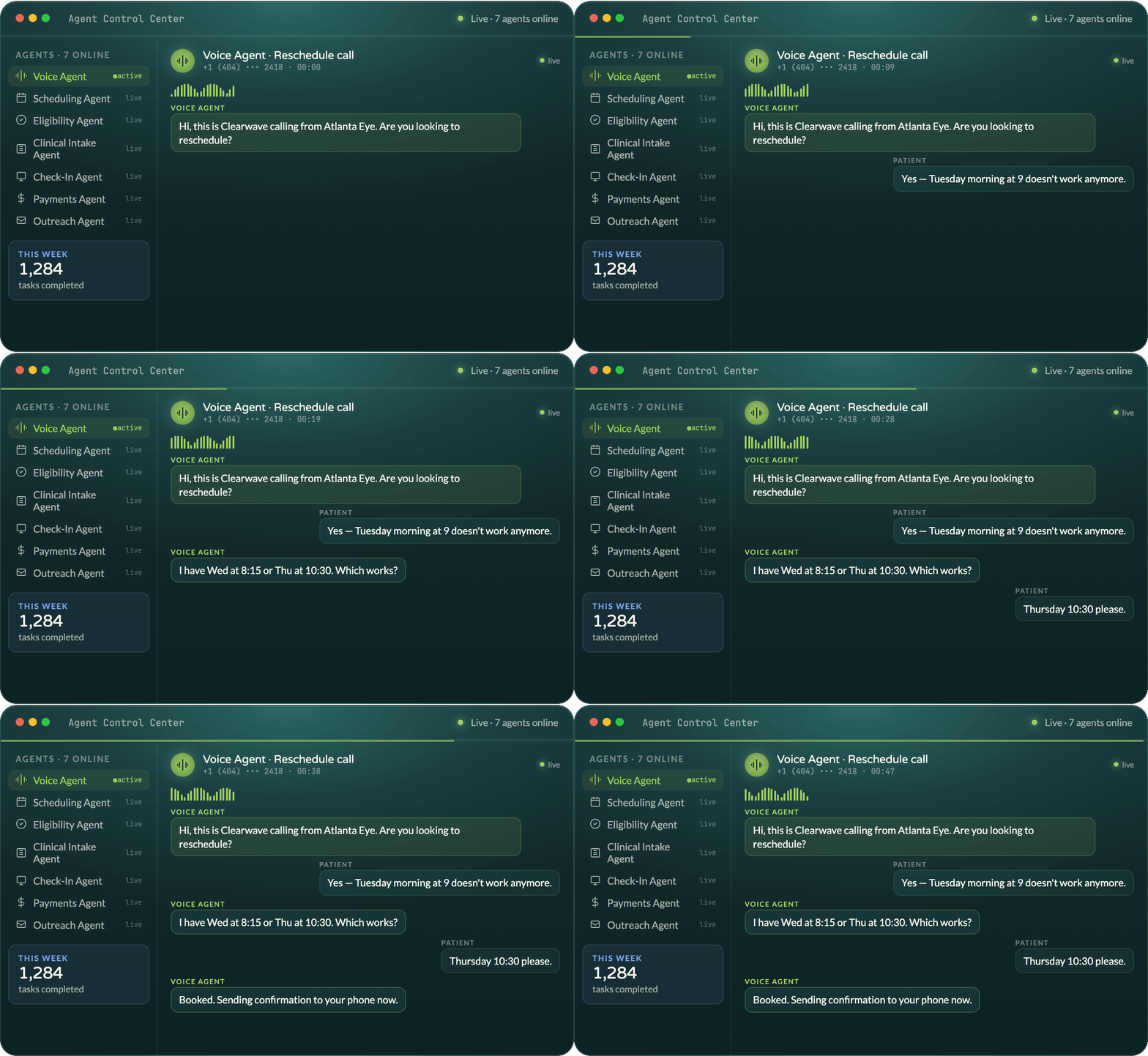
Rather than hiring toward a curve no fixed schedule can match, a growing number of specialty groups are supplementing front-office phone capacity with voice AI receptionists. Routine volume gets handled by agents that scale with the queue while anything needing judgment escalates to a person, so Monday at 8 AM gets peak coverage and Thursday gets only what Thursday needs, and patients who truly require a human aren’t waiting endlessly on hold.
Finding a proven healthcare voice AI solution
Before evaluating anything, pull four numbers from last Monday: call volume, answer rate, average hold time and abandonment rate. Most groups cannot produce all four on request, and that gap is telling.
See how Clearwave Voice AI gives practices peak phone coverage without peak payroll, answering every call in natural language, booking appointments and escalating what needs a person.
Learn more about the unanswered call problem costing healthcare organizations $120K every month.