




What Payment Strategies Are Healthcare Leaders Using to Protect Margins in 2027?
By Blakely Roth | October 14, 2026
Reimbursements are falling, self-pay volume is climbing and 100+ healthcare leaders just ranked the tactics they are using to respond.
Healthcare leaders named modern payment options (45%) and prompting for collections during pre-registration (44%) as their top two tactics for improving the bottom line in 2027, according to the 2027 AI Healthcare Leadership Priorities Report. Collecting more than co-pays at the point-of-service came in third at 36%. All three answers prioritize moving money earlier in the visit, see how.
Two outside forces are tightening practice revenue
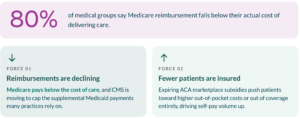
- Reimbursements are declining: Medicare already pays below the cost of care. Eighty percent of medical groups say Medicare reimbursement falls below what it actually costs them to deliver care, and CMS is moving to cap the supplemental Medicaid payments many practices rely on to close that gap.
- Fewer patients are insured: Expiring ACA marketplace subsidies are pushing patients toward higher out-of-pocket costs or out of coverage entirely. Self-pay volume goes up, and so does the share of revenue that has to be collected directly from the patient.
These two forces don’t arrive separately. Practices are seeing fewer insured patients and weaker collections at the same time that labor, supply and drug costs are climbing — and every denied claim pushes the remaining revenue further out.
Inside the practice, four constraints hit at once
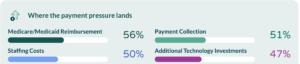
When asked to select which financial constraints will affect them most over the next 12 months, leaders named a few:
- 56% — Medicare and Medicaid reimbursement
- 51% — Payment collection
- 50% — Staffing costs
- 47% — Additional technology investments
The five tactics leaders are using to improve the bottom line
- 45% — Modern payment options (Apple Pay, Google Pay, tap-to-pay, card-on-file)
- 44% — Prompting for collections during pre-registration
- 36% — Collecting more than co-pays at the point-of-service
- 24% — Reducing FTE headcount
- 10% — Surcharging patient payments
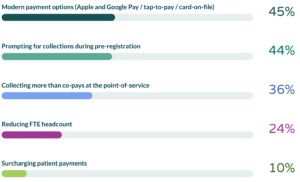
The two tactics at the top are the two that make paying easier and earlier. Modern payment modalities remove the friction at the moment a patient is willing to pay, and prompting during pre-registration asks before the patient ever walks through the door.
Collecting earlier is only half the revenue equation
The other half is keeping what you collect, and leaders have already named that play: AI for eligibility verification and denial prevention, the single largest area of AI investment in the survey at 50%.
The sequence is simple. Verify eligibility, register the patient earlier, collect prior to care and the claim goes out clean the first time. Errors get caught before the claim leaves, not after it comes back. Sheltering Arms Institute is a great example of this success in action, by running that sequence, the nationally recognized leader in physical rehabilitation continues to hold a 95% clean claim rate.

Surcharging is the strategy most leaders have not actually evaluated
A majority of respondents aren’t planning to add credit-card processing fees, though the most common reason has less to do with opposition than with not having looked at it closely yet.
This strategy cannot simply be written off. Surcharging is available to healthcare leaders looking to protect their bottom line without raising costs for every patient, and now is the time to consider every option at your disposal.
Using surcharging as a proven lever, healthcare organizations are attacking rising costs and reimbursement cuts — saving thousands of dollars that they would otherwise lose to processing fees.
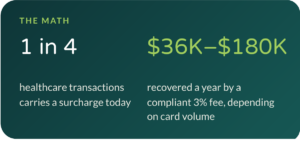
Done right, with automated compliance and clear patient disclosures, the experience is seamless for patients and the math is straightforward. See what a high-volume practice could save, or work through the risk side in Is Surcharging Worth the Risk?
What payment strategies will Mmake your 2027 plan?
Reimbursement rates and coverage policy are not levers that any practice controls. The collections process is. Modern payment options, prompting at pre-registration, cleaner eligibility upfront and an honest look at surcharging are all inside your realm of control and all four are where leaders are already moving.
See the complete annual report
The report covers the payments spotlight in full, plus the AI spotlight, year-over-year movement and how executives answered differently from everyone else. Download The 2027 AI Healthcare Leadership Priorities Report.