


How to Automate Insurance Eligibility Checks to Speed Up Patient Intake
By Chloe From Clearwave | September 2, 2026
A verified plan is only verified until it isn’t. 21.5% of insured patients switch coverage every year, and “eligibility expired” remains one of the top five reasons claims are denied. The check that passed at scheduling can fail at billing, making an already challenging task for staff that much more difficult.
Every manual check is another chance for a coverage change to slip through, and another time-consuming pass for staff while patients wait to complete check-in.
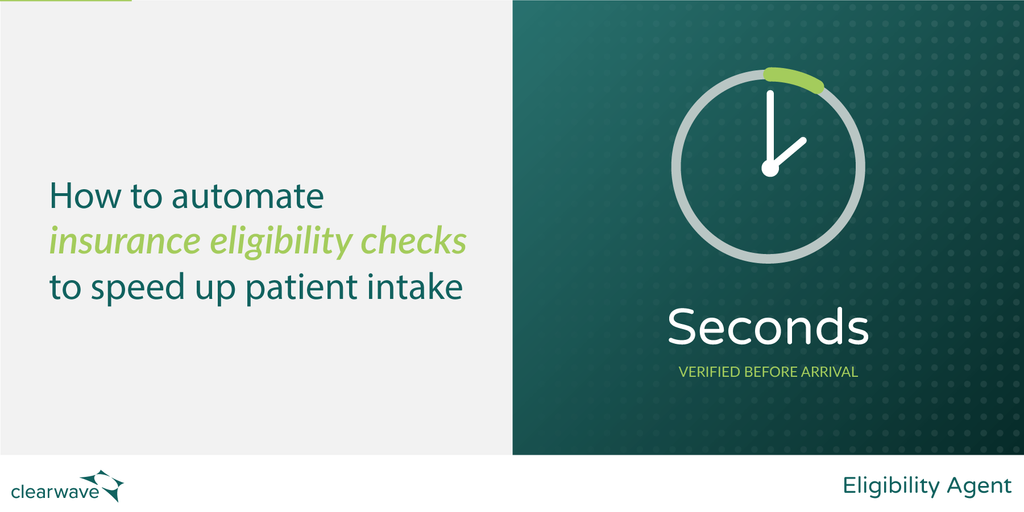
The fix isn’t verifying faster. It’s building intake so verification happens without anyone touching it. Here are five moves practices use to automate insurance eligibility checks from booking through check-in.
Replace Payer Portals and Phone Calls With Real-Time Checks
Automation starts with changing the mechanism, not the effort. Instead of staff dialing payers or juggling portal logins, healthcare organizations are automating the work with AI Eligibility Verification Agents that connect straight to payer databases and return coverage details in seconds.
Owning an automated insurance verification tool and getting time back from it are two different things. Plenty of practices run software that’s clunky to navigate or slow to respond, meaning staff ends up checking manually anyway. The tool is in place. The hours never come back.
Organizations seeing the most success use a solution that maintains connections with more than 900 payers and returns instant responses from over 99% of them. For example, Suncoast Orthopaedic shares how they use Clearwave to finish insurance verification before the patient walks in. That ease of use shows up directly in staff feedback. AnnMarie O’Malley at Suncoast Orthopaedic, who used Clearwave’s AI Patient Engagement Platform to streamline the entire pre-visit journey, says:
“Verifying insurance is a lot easier—our staff no longer have to switch between screens and payer sites.”
Clearwave Eligibility helps Suncoast get ahead of coverage discrepancies and protect claim integrity from the start. The impact carries into billing. “Clearwave’s Eligibility solution is more accurate than what our practice management system provides,” adds Lynn Holt, Practice Administrator.
“We’re seeing fewer claim rejections, which reduces issues down the line.” O’Malley adds, “A lot of our patients give us their Florida address, but their insurance is tied to their northern address. Clearwave helps us catch that early, instead of facing a rejection far later.”
With an advanced Eligibility Agent catching nuanced discrepancies automatically, Suncoast has seen the calls that once piled up around new-patient paperwork and eligibility drop by roughly 80%. Dive deeper.
The speed gain shows up immediately at the front desk, but the ripple effects go further. When verification runs electronically, new hires no longer spend weeks learning the quirks of a dozen payer websites. Practices report that automation drops insurance eligibility training time significantly, protecting intake speed through staff turnover and busy seasons.
That’s the foundation. The next four moves determine whether automation actually speeds up patient intake or simply digitizes the same bottleneck.
Trigger Eligibility Checks at Every Intake Touchpoint
A single automated check, run once before the visit, is still stale by the day of service, which is why the cadence matters as much as the mechanism. Build automated checks into the intake workflow itself:
- At Scheduling: Patient scheduling software that runs eligibility during booking catches coverage issues while patients are booking, so they can make updates on-the-spot.
- Multiple Times Prior to Visits: Re-verification in the days before the visit, like at pre-registration, catches changes that occurred between booking and arrival, which is especially valuable for follow-ups scheduled weeks or months out.
- At Check-In: A final check runs as the patient registers, confirming coverage is active and co-pays are accurate at the moment care is delivered.
High-growth practices verify insurance up to seven times per patient engagement, with each touchpoint catching a different category of change before it becomes a front-desk delay or a denied claim.
Verify at the Plan Level With Multi-Factor Eligibility
A yes/no coverage answer doesn’t speed up intake if staff still have to hunt down co-pays, deductibles and HMO assignments by hand.
Multi-Factor Eligibility verification goes beyond confirming active coverage to return plan-level detail: remaining deductible, co-pay tier, plan type, coordination of benefits, Medicare Advantage information and HMO/IPA assignments.
For example, Clearwave’s Eligibility Agent engine can check self-pay patients against Medicaid in real time, flag duplicate records and surface conflicts between what a patient entered and what the payer returned. When every check comes back with complete data, nothing gets researched manually while a patient stands at the desk.
When evaluating options, make sure to check that fee-free re-runs are included. When eligibility can be re-verified at any time without per-transaction costs, staff can confirm benefits again for back-end billing needs, like claim submissions after a global period of care, without hesitating over the expense.
Route Results Into One Dashboard That Flags Exceptions
Automated checks only accelerate intake if staff can act on the results quickly. Every payer formats its response differently, and forcing staff to decipher raw eligibility data patient by patient just relocates the bottleneck. The right software normalizes those responses into a single, all-patient dashboard where today’s schedule, eligibility statuses, co-pays and data conflicts all live in one view.
From there, staff stop reviewing records patient-by-patient and start working through exceptions. A flag appears when something demands attention, like an expired plan, a mismatched subscriber ID or a self-pay patient who actually has Medicaid coverage, and everything else moves through untouched. What used to consume hours of review becomes minutes of targeted follow-up.
Tiara Williams, Patient Registration Manager at Jordan-Young Institute, describes the effect:
“The dashboard makes us aware of these issues so we can proactively solve them.”
Errors get corrected days before the appointment instead of surfacing at the front desk, where they stall the line and frustrate patients. The dashboard also simplifies onboarding so that new staff learn one interface and one flagging system rather than a maze of manual verification workflows, getting them intake-ready in minutes instead of hours.
Auto-Post Co-Pays to simplify the Payment Motion
The final move closes the loop at arrival. With payer-appointment mapping, the eligibility engine matches the correct co-pay to each patient account automatically, so the patient registration software presents the accurate amount owed at check-in.
This is where speed and revenue converge. On average, a healthcare organization’s probability of collecting drops to just 30% once a patient leaves the office, so a check-in process that presents the right amount at the right moment directly protects revenue.
Practices using Clearwave Eligibility see the results across the board: a 94% drop in claim rejections, 500+ staff hours saved per year, $398K in additional revenue per provider and check-in times averaging around two and a half minutes.
How Fast Can Your Practice Get?
Automating insurance eligibility checks comes down to five moves: replace manual lookups with real-time checks, run them at every intake touchpoint, verify at the plan level, route results into one exception-flagging dashboard and auto-post co-pays at check-in. Practices that make these moves stop treating verification as a daily task and start treating it as infrastructure, and patient intake gets faster at every step.
See what that looks like in a live workflow. Grab a demo with the Clearwave team and watch automated eligibility catch the discrepancies your current process misses.