
Best Patient Engagement Software for Growing Federally Qualified Health Systems (FQHCs)
As Federally Qualified Health Centers prepare for a shifting healthcare environment in 2027, bottlenecks at the front desk may move from minor inconveniences to operational setbacks that cannot be overcome.
As patient volume climbs, the tools an FQHC relies on for scheduling, registration and communications will make or break operational goals and patient experiences. FQHCs must find the best patient engagement software to help them overcome 2027 hurdles.
See what capabilities separate a good patient engagement platform from a system that’s designed to grow alongside an FQHC’s mission, patient population and funding requirements.
What Makes Patient Engagement Different for a Growing FQHC
FQHCs serve diverse and often underserved communities, many of whom face barriers to care that go well beyond scheduling an appointment, from transportation gaps to language differences and hesitancy around sharing personal information.
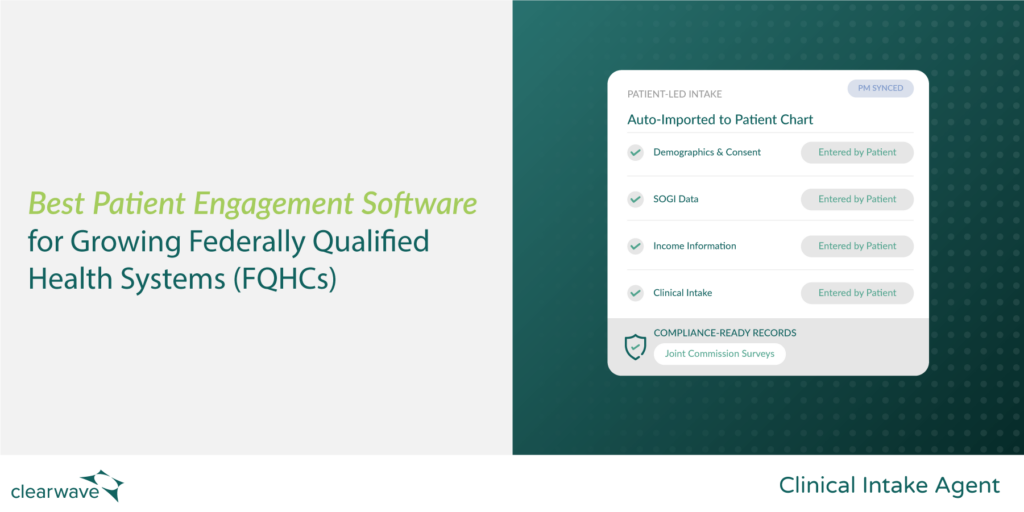
Every new patient touchpoint also carries federal reporting weight. Most FQHCs need to find seamless ways to capture data on race, ethnicity, income, housing status, veteran status and sexual orientation and gender identity to remain compliant with HHS reporting requirements and qualify for continued funding.
When that information is collected digitally and flows directly into the EHR, reporting becomes far less of a scramble, as Holyoke Medical Center discovered after modernizing its front door.
“A big value-driver is the data collection. It’s a strength Clearwave has that’s different than what other vendors can do with MEDITECH. The state is very pleased with what we’re able to produce, it’s better, more accurate data, flowing where we need it and it’s helped us get that much closer to being paperless.”
— Chris Giroux, Director of IT Application Services, Holyoke Medical Center
Layer on complex funding requirements, lean administrative teams and the pressure to see more patients, and it becomes clear why generic patient engagement tools fall short. The best FQHC patient engagement software has to do more with lean staffing numbers as patient volume climbs across every location.
Core Capabilities of the Best FQHC Patient Engagement Software
Not every patient engagement platform is built to handle the operational complexity of a growing FQHC. Before evaluating vendors, health system leaders should look for a short list of core capabilities that hold up as volume and locations increase.
- Voice AI that answers patient calls in natural, conversational language, handling routine questions, booking appointments and routing prescription refill requests without staff intervention, with support for 13 languages to serve multilingual communities.
- Patient self-scheduling that lets patients book, reschedule or cancel appointments anytime, cutting down on inbound call volume as locations and provider counts grow
- Personalized appointment reminders that adapt to what each patient has already completed, so patients who finish pre-registration or clinical intake stop receiving repeat nudges, an approach that helped Kennedy Community Health reach 88% clinical intake completion
- Provider-led welcome and education videos that help new patients feel oriented and prepared, building trust and setting expectations before the first visit.
- Patient-led registration and kiosks that collect demographic and consent data directly from patients, reducing the burden on front-desk staff while improving data accuracy.
- Real-time insurance eligibility verification that checks coverage multiple times before a visit, catching lapses before they turn into denied claims
- Automated, multi-channel patient outreach that keeps patients informed via text, email and voice without adding to staff workloads
- A centralized staff dashboard that gives administrators visibility into outstanding tasks, insurance flags and daily check-in activity across sites
These capabilities form the foundation of the best FQHC patient engagement software, one that reduces manual work at the front desk while improving the patient experience from first contact through follow-up care, no matter how many locations sit behind the schedule.
Scaling Registration and Revenue as Patient Volume Grows
East Jordan Family Health Center offers a clear picture of what happens when the right technology meets FQHC-scale patient volume. The Michigan-based health center operates two locations, has 12 providers and sees around 3,000 patients a month.
Before implementing Clearwave, EJFHC relied on manual check-in, which slowed intake and made it difficult to capture sensitive data like SOGI and income information in a way that felt comfortable for patients. Site Director Kassandra Duby explains what changed the equation:
“We wanted important information to automatically import into patient charts in our practice management system to create a more efficient workflow. That’s what led us to Clearwave.”
Today, EJFHC sees 80% of patients self-register using kiosks, with average check-in times of just over a minute and a half. The health center also collects an 82% monthly co-pay collection rate alongside more than 3,000 automatic patient data updates every month.
Meeting Compliance Requirements Without Adding Staff Burden
Compliance is not optional for FQHCs, and it does not get easier as patient volume grows. Joint Commission surveys, HRSA reporting and internal audits all depend on consistent, accurate documentation across every location, often reviewed on short notice.
Standardized, patient-led intake is especially important here. When patients enter their own information, rather than staff transcribing it during a rushed visit, data accuracy improves and staff spend less time chasing down missing forms after the fact. Duby put it plainly when describing why data collection was a top vendor requirement:
“When evaluating vendors, our top priority was capturing SOGI data in a way that was comfortable for patients.”
The result is fewer manual corrections, more complete records for federal reporting and a smoother path toward strong Joint Commission survey outcomes, all without asking already-stretched staff to do more during a survey cycle or a growth push.
Personalizing Engagement Before, After and Between Visits
Compliance and revenue matter, but so does making patients feel seen.
Growing FQHCs are finding that personalization doesn’t have to slow down as patient volumes rise. The strategy for personalization just has to be built into the technology instead of relying on staff time alone.
Before a first visit, some health centers now send personalized, AI-powered welcome videos featuring patients’ own providers, helping new patients feel prepared rather than anxious about what to expect. On-site, patient-led kiosks let people register in their preferred language and at their own pace. This approach can matter significantly for populations with varying levels of digital comfort, mobility and access needs.
Between visits, the opportunity to personalize doesn’t disappear. By analyzing no-show patterns and patient behavior, FQHCs can adjust reminder timing, messaging channels and outreach content to better match how patients actually want to be reached. This step helps to turn missed appointments into a data source rather than a lost slot.
This kind of personalization works because it scales without adding staff hours, the same welcome video, kiosk workflow and reminder logic can serve one location or a dozen.
Choosing the Right Patient Engagement Partner for FQHC Growth
Growing an FQHC means asking more of every system already in place, like scheduling, registration, eligibility, collections and compliance all have to hold up under greater volume without a proportional jump in staff. The best FQHC patient engagement software is the one that carries that weight quietly, in the background, while keeping the focus on patients and communities rather than paperwork.
See what that impact could look like for your health center with Clearwave’s ROI calculator, or grab a demo to see the platform built for FQHC-scale growth in action.