




What Healthcare Leaders Want AI to Solve in 2027
By Blakely Roth | September 30, 2026
New survey data from 100+ healthcare leaders puts the phone lines and denied claims at the top of the list.
Healthcare leaders want AI pointed at two problems — phone lines and claim rejections. In the 2027 AI Healthcare Leadership Priorities Report, a survey of 100+ healthcare leaders, 59% named patient hold times and abandoned call rates as the problem AI is best suited to solve, while in the next breath 51% said they’re investing in AI right now to solve for claim rejections and denials.
AI Went From an Emerging Idea To a Top Priority In One Year
A year ago, “AI utilization” was an idea on the radar for 16% of respondents. Heading into 2027, it is a top operational priority with results behind it. The shift tracks with what is happening at the front desk. Among practices that track call abandonment, nearly 1 in 6 are missing 25% or more of their calls at peak hours. Every one of those calls is a booked appointment, a rescheduled surgery or a patient question that never got answered.
Which problems should AI solve?
Leaders were asked which problems AI is best suited to solve. They answered:
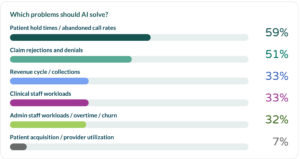
- 59% — Patient hold times and abandoned call rates
- 51% — Claim rejections and denials
- 33% — Revenue cycle and collections
- 33% — Clinical staff workloads
- 32% — Admin staff workloads, overtime and churn
- 7% — Patient acquisition and provider utilization
Where is AI investment going in the next 12 months?
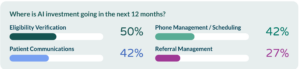
- 50% — Eligibility verification
- 42% — Phone management and scheduling
- 42% — Patient communications
- 27% — Referral management
The order matters. Eligibility verification ranking first says leaders are buying denial prevention, not just front-desk convenience. In order to reduce billing stalls, healthcare leaders want the error caught before the claim goes out, not after it comes back.
Why phones and denials show up together
Phone and denial challenges are the same staffing problem at two ends of the same visit. When the front desk is underwater, voicemail queues build at the start of the patient journey and preventable denials surface at the end due to errors never caught along the way.
In the next few months, leaders are moving the most repetitive work off their teams entirely so they can save staff for the healthcare complexities automation simply isn’t built for. For example, Voice AI for call handling can reduce overall phone traffic by answering and resolving calls, without staff intervention, even by booking patients or starting an RX request. At the next step in the patient journey, AI eligibility tools can run in the background and auto-solve errors. These tools can flag issues for staff prior to patient appointments, leaving staff to only intervene on the challenging issues that require their full attention.
What does this look like in action? The agents work alongside staff, and staff spend the time they get back on the patient in front of them.
Executives are pushing harder than everyone else
Split the data by seniority and the gap is hard to miss. VPs and executives back AI for revenue cycle and collections at 55%, versus 28% for everyone else.
For patient communications, it is 70% versus 35%. And 80% of that group named staffing costs as their top financial constraint, compared with 43% of the rest of the organization.
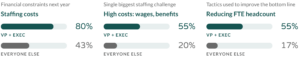
VP and executive responses vs. everyone else. Source: The 2027 AI Healthcare Leadership Priorities Report, Clearwave. Survey of 100+ healthcare leaders.
Voice AI priority also climbs with every step up in size: 24% at organizations with 1–25 providers, 29% at 26–99 and 38% at 100+.

In the corner office, AI is a cost question. On the floor, it is a workload question. Both roads end in the same place.
One platform, not ten vendors
Phone calls, eligibility verification and payments are usually treated as three separate problems with three separate vendors. At the same time, AI is new enough that solutions are coming out of the woodwork claiming to automate all three. Leaders patch point solutions together with their PM System and find out the hard way that many new-to-market tools are not actually reducing workloads in healthcare.
The organizations seeing the strongest results run multiple steps of the patient journey through one platform instead of ten vendors.
See the Full 2027 Report
The report breaks down the year-over-year movement, the payments spotlight and how executives answered differently from everyone else. Download The 2027 AI Healthcare Leadership Priorities Report.